How the Together4Cancer® Beacon works

How it works

Meet Together4Cancer® Beacon

It takes what you already have and turns it into the questions worth asking first. Not a general chatbot. Not a symptom checker. Not another eighty-question printed list. You bring your reports, results, and questions, in your own words, in any language. Beacon creates a map for the decisions ahead.

Come back whenever something changes, new information arrives, or before your next appointment. For 90 days, Beacon carries your context forward and rebuilds the map around where you are now.

01
Start

Bring what you have

Type it, paste it, upload it, or talk to it, in any language. A pathology PDF. A phone photo of yesterday's labs. A list of symptoms from your notes app. Ask the questions you've been carrying, including the ones you've been afraid to say out loud. You don't need to organize it first.

02
Get answers

Answers grounded in your situation

Answers come back grounded in your specific situation and current oncology evidence: your tumor profile, your stage, and what’s already been proposed. Not general information about your cancer type.

03
Act

Know what you can do next

When there’s a practical next step, Beacon helps you see it: who may be able to help, what to say, and the words to use in a portal message or at your appointment.

04
Walk in prepared

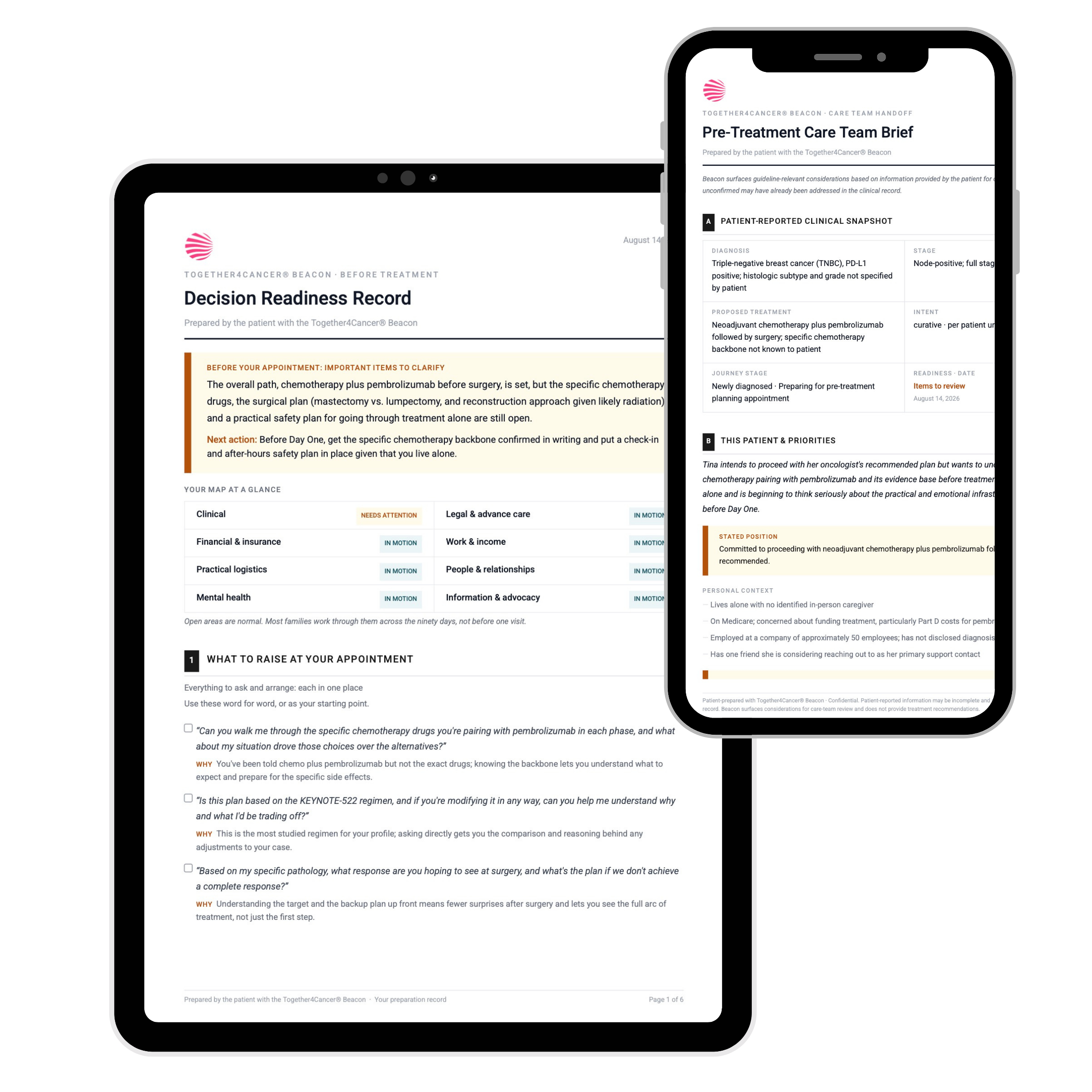
Walk in with two documents

One for you: your prioritized questions and what to confirm, with whom. One for your oncologist: a summary of where you are and what you came to discuss. You hand it to the nurse before your doctor walks in.

See it in action

Watch it turn a report into questions that matter now.

Ninety seconds, start to finish. The patient is fictional and the session is scripted, so nothing here is anyone’s real case. Nothing to sign up for.

A demonstration of the Together4Cancer® Beacon. Scripted sample using a fictional patient. Educational only. Not medical advice, and not a substitute for your care team.

From people who’ve used Beacon

What it was like for them.

I was in pathology for 20 years and I just couldn’t figure out how to talk about it.

It was awesome! I was specifically looking for how to word my discussion with my oncologist on the need for better surveillance imaging (pleomorphic lobular, onco score 34, Pr neg) and also repeating the FISH (group 2 from biopsy) on the excision of the tumor (lumpectomy). I found it very validating and it gave me the tools and confidence to bring these issues up with him. And I was successful after pushing a little!

DeborahPatient with breast cancer · 20 years in pathology

The questions don’t stop, even when treatment is working.

My wife was diagnosed with Stage IV lung cancer in December 2022. Three years in, she’s doing well, and at every monthly visit, you still wonder what you might be missing. Your care team is eager to help, but they have hundreds of patients. You have to know what to ask.

This showed me exactly what to bring up, about side effects, about monitoring. A clear map for what comes next.

OmkarCaregiver · Lung cancer

It provided me with much-needed clarity, guidance, and the right questions to ask my medical team.

I was recently diagnosed with a very rare cancer called PEComa. The information on treating this cancer is extremely limited, I found this app to be an invaluable resource that provided comfort during a very difficult time.

If you are considering using this tool, I highly recommend it. I truly believe it is one of the best tools available for anyone trying to advocate for themselves and navigate the complexity of cancer treatments.

Name withheld on requestPatient with a rare cancer

I received frequent comments from my doctors about how prepared and well informed I was.

This tool helped me prepare for doctor visits and made me aware of questions to ask, the language to ask them in, and options for diagnosis and treatment that were never presented by my first oncologist. Thanks to its suggestion I got a second telehealth opinion through MSK on very short notice, ultimately changing oncologists and going into a clinical trial testing a better-tolerated chemotherapy.

It provided focus for doing further research on my own and empowered my self-advocacy. I found it very comforting and helpful when trying to get up to speed during a whole new set of unfamiliar experiences.

Name withheld on requestPatient · Changed oncologists, joined a trial

Is This For You?

This might not be for you if

  • You’re looking for a diagnosis, treatment recommendation, or replacement for your oncology team.
  • You want a tool that makes medical decisions for you.
  • You’re looking for guaranteed outcomes from using Beacon.
  • What you primarily want is a cancer community or patient forum.

This is for you if

  • You’ve been newly diagnosed and treatment decisions are already moving quickly.
  • You’re in treatment and a new result, symptom, scan, or change to the plan has brought new questions.
  • You have an oncology appointment coming up and want to walk in with a plan, not a stack of tabs.
  • You trust your care team, but know there’s only so much that fits into one appointment.
  • You’re caring for someone with cancer and want to know what to pay attention to, what to ask, and where you can actually help.
  • You’ve left an appointment and remembered the question on the drive home.
  • You want fewer, better questions, not another eighty-item checklist.

Maybe you’re thinking: I already have access to AI. Why would I pay for this?

Why not just use ChatGPT?

ChatGPT can answer cancer questions.
Beacon is built to help you navigate cancer decisions.

ChatGPT / general-purpose AI
Beacon
Where it starts
ChatGPTYou decide what to upload, what to ask, and where to take the conversation.
BeaconBring what you have and what’s on your mind. Beacon helps surface what matters, what still needs clarification, and what may be worth asking next.
How it uses evidence
ChatGPTCan draw on broad knowledge and current sources, depending on the tool and how you use it.
BeaconUses an oncology-focused evidence base and decision framework built specifically around cancer-care decisions. How the evidence works →
Who structures the process
ChatGPTYou direct the conversation and decide what to explore next.
BeaconBeacon structures the process around your clinical context, questions, priorities, and the decisions ahead.
What carries forward
ChatGPTYou manage which details, answers, and unresolved questions need to stay in the conversation.
BeaconBeacon carries forward what’s been answered, what remains open, and what may need attention next.
What you leave with
ChatGPTWhatever you ask the AI to help you create.
BeaconA Decision Readiness Record for you and a Care Team Brief for your clinician, ready for your next appointment.

The difference isn’t access to AI.
You already have access to extraordinary AI.

The difference is who has to direct the process.

With general AI, you decide what to bring in, what to ask, what to explore, and what needs to carry forward.

Beacon gives that process structure, so you don’t have to become an expert at prompting AI while you’re trying to navigate cancer. You bring what you have. Beacon brings the structure.

Treatment doesn’t wait for you to catch up. The scan, the result, the next cycle: new information keeps arriving, and with it, new decisions.

Two phases · One Beacon

Cancer care isn’t one decision.
It’s a sequence of them.

Phase 1

Before Treatment Begins

The stretch between diagnosis and treatment can hold some of the most time-sensitive questions: biomarker testing, trial eligibility, treatment options, fertility, and the financial, work, family, and practical decisions that may be harder to revisit later.

Phase 2

Through Treatment

Once treatment begins, the questions change. New symptoms. Changes in what you can do day to day. Scans and results. Whether treatment is working. What needs attention now, what can wait, and what your care team needs to know before the next visit.

One Beacon
As your care progresses, Beacon shifts with you from Before Treatment to During Treatment. Your context comes with you.

Every Beacon conversation can become two documents ready for your next appointment:

  • For you: what matters now, the questions worth asking, and the words to use.
  • For your care team: what’s changed, your priorities, what remains unresolved, and what needs to be discussed.

Your voice gets into the room. Your care team gets the context. You make the decisions together.

Cancer doesn’t stay in the exam room. Neither do the decisions it forces you to make.
There’s still work, money, family, logistics, and the rest of your life waiting outside that door.

The map

The Eight Decision Domains: Because Cancer Isn't Only Clinical

02

Legal and advance care

Healthcare proxy, advance directive, goals of care conversations you didn't know you needed to have yet.

03

Financial and insurance

Manufacturer assistance programs, forecasting out-of-pocket costs, navigating appeals.

04

Work and income

FMLA timing, when and how to disclose to your employer, disability planning.

05

Practical logistics

Caregiver coverage, transportation to and from treatment, managing daily life through treatment cycles.

01 · runs for everyone, every time

Clinical

Biomarker testing, clinical trials, tumor board review, fertility preservation, treatment sequencing, side effects and symptom management.

06

People and relationships

How to tell your kids. What your spouse can realistically carry. Who takes which support role.

07

Mental health

Recognizing distress signals, in yourself or your caregiver, and knowing what access to counseling actually looks like.

08

Information and advocacy

Getting your own records, navigating your care team, prioritizing your own questions.

The clinical domain runs for everyone, automatically. For the other seven, you decide where your time and attention go. Nobody hands you this map on diagnosis day. The Beacon does.
"I built it so fewer families ever have to say: I wish I'd known that sooner."

I’m Shruti Agarwal, PhD. I’ve spent 24+ years across research, oncology medical affairs, and cancer care, and I’ve also been the caregiver in my own family.

I built Together4Cancer® Beacon to help patients and caregivers find their voice in the decisions happening around them, especially the questions they may not know exist until the window to ask them has passed.

Beacon is grounded in published oncology literature and built to keep pace as the evidence changes. Your conversations are private and encrypted.

Beacon is an educational tool, not medical advice. Every medical decision stays with you and your care team. What you share is encrypted, never used to train AI models, and never sold.

@together4cancer · follow the work on Instagram

Ready to see what it includes?

The 90-Day Beacon Pass: unlimited access from diagnosis into treatment.

Get My 90-Day Beacon Pass → $147 once · 90 days · No subscription · Instant access